
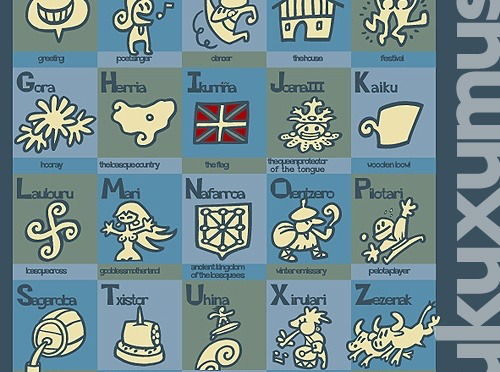
The most basic element of a written language is the alphabet. However, because Euskara wasn’t standardized until the 1970s, spelling of Basque names and words was all over the place, often borrowing from Spanish and French. With standardization, the chaos finally settled and now there is a common alphabet used in all parts of the Basque Country. Those who standardized the alphabet and orthography made some interesting choices – using the letter x to represent the ‘sh’ sound and tx to represent ‘ch’ – that I haven’t been able to find why. If anyone knows, please leave a comment!
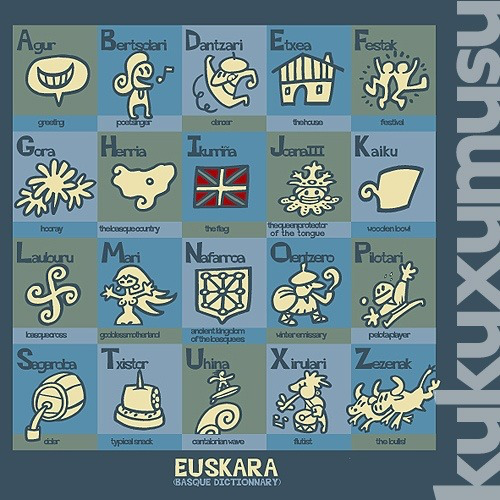
- Formally, the Basque alphabet has only 23 letters – a b d e f g h i j k l m n ñ o p r s t u x z. The letters c q v w ydo exist, but are typically only used in foreign words and names.
- h is a bit interesting as some dialects of Basque use it, particularly in Iparralde, while others don’t. When Euskara was being standardized in the 1970s, it was decided to use the h in some words and not in others. It is voiceless in Batua – the unified standard Basque – but is vocalized in some dialects. The choice to include it in some words and not in others caused consternation for everyone.
- Another interesting letter is x, which is pronounced like ‘sh’ in English.
- z is also interesting. It represents the ‘s’ sound, much like (but subtly different) from the Basque letter s. However, because of the influence of Spanish, I’ve heard it pronounced more like ‘th,’ so that, for example, my grandmother’s surname Zabala, which should be pronounced like Sabala, is sometimes pronounced like Thabala.
- There are also digraphs – pairs of letters that represent unique sounds – just like ‘ch’ or ‘th’ in English. In Basque, these are:
- dd: this is a bit softer sound than normal d but doesn’t really have an English equivalent (as far as I can tell). Some dialects don’t have this sound.
- ll: much like in Spanish, this sounds like ‘y’ in English
- rr: this is trilled much like in Spanish
- ts: this is pronounced much like the ‘ts’ in ‘rats’
- tt: softer than ts or tz, but similar in spirit (again, I don’t know of an English equivalent)
- tx: this is the ‘ch’ sound in English, like in the word ‘chair’
- tz: this is a bit harder than ts and is pronounced like ‘ts’ in ‘gets’
- ñ is like the ‘ni’ in ‘onion.’ The combination ‘in’ in Basque has a similar sound.
- Because Basque was only standardized within the last century, before that words were written with either Spanish or French orthography. So, modern Basque Etxebarria would be Echevarria or Etchevarria.
- Finally, it is interesting to look at where some of the letter choices come from. As the last example demonstrates, Basque uses tx for the ‘ch’ sound while the neighboring languages do not. Catalan also uses tx for the ‘ch’ sound. Maybe Basque took inspiration from Catalan? I can’t find anything that says anything about the origin of using tx to represent the ‘ch’ sound…
A full list of all of Buber’s Basque Facts of the Week can be found in the Archive.
Primary sources: Basque by Larry Trask, Buber’s Basque Page; Euskera, Wikipedia