


|
Hasiera · Home |
|
Ezaugarriak · Features |
|
Oharrak · Notes |
|
Sarrera · Introduction |
|
Euskara |
|
Folklore |
|
Kirolak · Sports |
|
Musika · Music |
|
Janedanak · Gastronomy |
|
Tokiak · Places |
|
Historia · History |
|
Politika · Politics |
|
Diaspora |
|
Internet |
|
Albisteak · News |
|
Nahas Mahas · Misc |
For security reasons, user contributed notes have been disabled.
by Blas Pedro Uberuaga
June 28, 2003
Read: December 2000 to January 2001.
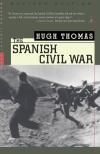 In his very interesting book, Hugh Thomas starts with the events that
lead up to the Spanish Civil War and then follows on with the details
of the war itself. From a Basque point of view, any understanding of
the political situation today requires a familiarity with the Spanish
Civil War, and this book delivers.
In his very interesting book, Hugh Thomas starts with the events that
lead up to the Spanish Civil War and then follows on with the details
of the war itself. From a Basque point of view, any understanding of
the political situation today requires a familiarity with the Spanish
Civil War, and this book delivers.
The Basques are often labelled as communists for their role in the war. It is true that they were on the side of the Republic, which was the legitimate government in Spain before the war started, and the Republic contained many influencial communists. But, the Basques were in the war to protect both their hopes of autonomy as well as the liberty they cherished, which the Nationalists (Franco and the Carlists) wanted to eliminate.
The Republic was forced to go to the Soviets for aid, both for supplies and expertise, as the democracies of Europe and the United States wouldn't supply any. The reason was because of the Non-Intervention Committee, a committee set up by the British, French, Soviets, Germans, and Italians, amoung others, to prevent any of the powers of Europe from intervening in the war. However, the Italians and Germans still supplied Franco with supplies and personel. The British and French were too fearful of the war escalating to a larger, European war. Thus, the Italians and Germans were able to help the Nationalists without the Republic receiving much aid. The Soviets were able to supply some aid, though it wasn't enough to prevent the Republic from losing.
The Basques were conquered by a lack of supplies and also because of treachery. At least, at the end, Bilbo was conquered, in no small part, because of the treachery of a Basque officer who defected and revealed details about the defences of the city. The Basques were always different from the rest of the Republic, in that one group, the Basque-Nationalists, had control of the government and the army. This wasn't true in the other parts, where the Communists and Anarchists were generally in control.
The Republic was handicapped by more than just supplies, but also because of constant squables between the Communists, Socialists and Anarchists. The Anarchists were actually in control in Barcelona, something Thomas points out was the first time Anarchists had been in control of a major city anywhere in the world. They had several changes of government as they tried to be accomodating to the more powerful groups not represented in the current government. The lack of stability and the lack of supplies were the reasons that the Republic lost to the Nationalists. The Nationalists were able to get supplies at just the critical moments and the Republic was not.
To a modern reader, it seems like the war was fought a bit ineptly on both sides. That is, neither had any kind of superiority in terms of military capability and both made many big mistakes.
Both sides committed many atrocities. The Anarchists killed many religious people or Fascist sympathizers wherever they gained control. The Fascists did the same to Communists and also attacked many religious people in the Basque Country since they sided with the Basques.
The war was an experimental test-ground for the Italians and, even more, the Germans, who tested combat strategies as well as ways to employ air force and tank formations, in preparation for future wars. The future Allies of World War II learned the wrong lessons, especially in terms of how to use tanks, which caused many failures in WWII.
This book is a typical history book, describing a lot of details, but it also has some remarks by the author that both lightened the tone as well as giving his personal feelings about some of the events.
The Spanish Civil war defined Spanish history from then on. It also lead to some of the happenings of WWII, as the Germans and Italians were able to go unchecked in their response to the war and this undoubtedly gave them confidence that they could achieve whatever they wanted without reprecussions from France and England. This book is a fitting testament to this monumentous event.
|
Please report any problems or suggestions to Blas. Eskerrik asko! |


