


|
Hasiera · Home |
|
Ezaugarriak · Features |
|
Oharrak · Notes |
|
Sarrera · Introduction |
|
Euskara |
|
Folklore |
|
Kirolak · Sports |
|
Musika · Music |
|
Janedanak · Gastronomy |
|
Tokiak · Places |
|
Historia · History |
|
Politika · Politics |
|
Diaspora |
|
Internet |
|
Albisteak · News |
|
Nahas Mahas · Misc |
For security reasons, user contributed notes have been disabled.
|
News from |

The Harvill Press |
|
Morse Partners
for immediate release |
|
The Lone Woman by Bernardo Atxaga "The literary road I’ve made across the desert is very different from that of a writer born in Madrid. We start from humiliation when we write in Basque. It’s the darkness that pushes us."
|
|

"It’s tribute to the quality of the writing that politics and philosophy—how we live and how we die—become the real business of a police thriller . . . Again he has proved himself among the most versatile, riveting, gifted and—unexpectedly—lyrical of contemporary authors."
—Amanda Hopkinson, Independent on Sunday
The mind of an ex-prisoner
Always returns to prison.
In the street he passes judges, prosecutors and lawyers
And the police, though they don’t know him,
Look at him more than at anyone else,
Because his step is not calm or assured, because his step is too assured.
Inside him lives
A man condemned to death
—Page 25, quoted from Joseba Sarrionandia
THE LONE WOMAN is a story of a 37-year-old, divorced, unnamed (and therefore nameless) woman imprisoned for terrorist activities on behalf of Etarra, the Basque separatist movement better known as the ETA. This is her first day out of prison after a four-year stretch, and when we meet her she has just left the hotel where she in turn has left a man she picked up during a night of drinking. She has nowhere to go, and that being the case she has no alternative than to go home—home to Bilboa in the Basque country, her homeland. The shortest passage between her prison stint (and possible criminal charges for cutting up her date the previous night) and her former life is on a bus, and it is over the course of this journey that we learn that story of her life, and possibly of its end.
But the beauty of Atxaga’s writing is that the action of the novel, spirited as it is, is never as absorbing as the mental drama. Of course, what is suspense if it’s not psychological? Bernardo Atxaga’s THE LONE WOMAN, as his companion book THE LONE MAN, delves into fear, oppression, our inner lives, and how we arrive at the choices that we make. It is also about prisons: only the kind in which you are shut up but also those into which we lock ourselves. The ex-con of THE LONE WOMAN—scared, confused, touching and very human—is caught between those two confines, and within their interplay is something of and for all of us.
She closes her eyes and shook her head. She must stop playing these games, she must keep calm and try to control the thoughts buzzing around her head like a swarm of bees, only to end up always in the same place: prison.
Rose Marie Morse, President; Sam Truitt, Vice President
Morse Partners 50 East 80th Street, Suite 2 New York, NY 10021 Tele: 212-988-1197 Fax: 212-517-5652
In THE LONE WOMAN we meet through her ruminations her former cellmates the clairvoyant Margarita and the troublesome Antonia; both her siren, dead lover Larrea, killed in an ETA action, and ex-husband Andoni; two nuns girded with angelic mercies; her bloated, one-night-stand thug left bleeding a Madrid hotel room; and the cops on her trail dragging to the surface her former life in all its menacing and deadly detail. We also meet, by way of quotation, Carl Sandburg, D.H. Lawrence, Emily Dickinson, William Blake, The Smiths, Stevenson, Stendhal and anonymous Basque singers. Cornered in a bus for eight hours, all these voices and figures come together to reiterate with great force and veracity this Basque woman’s life in all its sadness, resignation, betrayal.
Bernardo Atxaga, a literary and cultural hero to the Basques, casts in THE LONE WOMAN a sascination, penetrating look into the dynamics the words freedom, nation, oppression and servitude trigger in a people. His sympathy is with those individuals ground down between the jagged borders of countries; and into those individuals Atxaga breathes a brave and unique culture.
"When the sea is stormy, it is that much stronger. We have to be strong or we will disappear."
—Bernardo Atxaga
~~Praise for THE LONE MAN~~
In THE LONE MAN he expresses for his people, in their own lagnuage, the complexity of their situation. This is the key to his success in the Basque country, and with the translation of his work we, too, can begin to grasp it.
—Juliam May, The New Statesman
Atxaga has a sharp sense of detail, great emotional wisdom and a unique vantage point on the obsessions of a bitter and paranoid community.
—John Butt, London Telegraph
This is a crackling, tense and inventive thriller . . .
—Sharon Walter, Shropshire Star
. . . this book flashes with steely insights. It is also endowed with a page-turning power that speeds up impressively in the closing chapters.
—Paddy Woodworth, The Irish Times
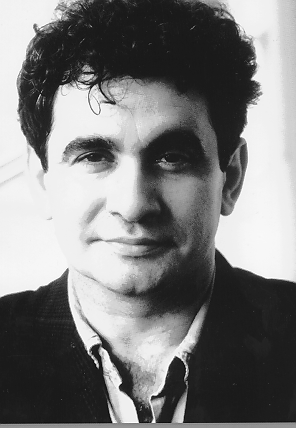
ABOUT THE AUTHOR
|
|
Bernardo Atxaga, born in 1951, writes in one of Europe’s oldest languages—Euskera, the Basque language forbidden in Franco’s Spain—asnd he is one of only ten Euskera writers in history to be translated into English. Atxaga pulbished his first work at the age of twnety in an anthology of Basque writers. Sine then he has written plays, children’s books, radio scripts, and novels, including Obabakoak (which has been published in 14 languages, and has won both Spanish and European literary awards) and The Lone Man, published last year by Harvill. The Lone Man and The Lone Woman mark a departure for Atxaga’s earlier work: what was before profuse, intricate and imagistic has been stripped back to bare branches.
|
ABOUT THE TRANSLATOR
MARGARET JULL COSTA is also the translator of works by Bernardo Atxaga and Javier Marías. Her translation of Fernando Pessoa's The Book of Disquiet won the Portuguese translation prize.
|
The Lone Woman by Bernardo Atxaga Translator: Margaret Jull Costa Publisher: Harvill Press (distributed by Farrar Straus & Giroux) Publication Date: June 16, 1999 Price: $21.00 Category: Fiction/Thriller Pages/Format: 160 pages/Hardcover ISBN: 1-86046-421-1 |
The Harvill Press |

For more information, author photograph or to interview the author or publisher, please contact Rose Marie Morse or Sam Truitt, Morse Partners, at 212-988-1197 or via email rosemarie1@msn.com.
|
Please report any problems or suggestions to Blas. Eskerrik asko! |


